Your Space Is Telling You Something.
Are You Listening?
Indoor occupancy control and people counting give you real-time visibility into how your space is actually used — improving safety, reducing operating costs, and enabling smarter decisions in retail, offices, gyms, and public buildings.
Most businesses and facility managers operate on assumptions about how their spaces are used. They assume the busiest hours match the scheduled peak periods. They assume staffing levels align with actual visitor demand. They assume their store layout is guiding customers where they intend. They assume their building is within safe occupancy limits during busy events. In reality, these assumptions are often wrong — and the cost of being wrong is measurable.
Indoor people counting and occupancy control replace those assumptions with facts. A sensor above each entrance counts every person who enters and exits — continuously, automatically, and accurately. The data flows to a dashboard where managers can see current occupancy in real time, review historical patterns by hour and day, and receive alerts when thresholds are approached. That shift from assumption to evidence changes how spaces are managed, staffed, designed, and funded.
What surprises most organisations when they first deploy an indoor counting system is not what the data confirms — it’s what it contradicts. The peak hour is an hour earlier than scheduling assumed. The entrance that seems busy is actually handling far lower volumes than the side entrance no one considered optimising. The Monday morning opening shift is consistently over-staffed while Wednesday afternoons run short. The data reveals the reality that daily observation, however experienced, consistently misses.

How many people are in your space right now? Indoor people counting answers that question — automatically and continuously
Indoor people counting is not a sophisticated technology solution to a simple problem. It is a simple solution to problems that cost real money every day — overstaffing during quiet periods, understaffing during peaks, unsafe occupancy during events, and retail layouts that guide customers away from high-margin products.
Who Needs Indoor Occupancy Control — and Why
The organisations that benefit most from indoor people counting share a common characteristic: they make decisions about staffing, space, operations, or investment based on assumptions about how many people use their spaces and when. That covers a wide range of facility types — each with its own specific reasons why accurate occupancy data changes operations.
🛍️ Retail Stores & Shopping Centres
Footfall counts, conversion rate calculation, peak period identification, store layout optimisation, and multi-site performance benchmarking. The foundation of retail performance analytics.
🏢 Offices & Corporate Campuses
Space utilisation data to right-size real estate, manage hybrid work patterns, understand meeting room demand, and reduce the cost of maintaining underused floor space.
🏋️ Gyms & Fitness Centres
Capacity management to prevent dangerous overcrowding, real-time occupancy displays for members, peak-period staffing alignment, and equipment utilisation insight.
📚 Libraries & Public Buildings
Visitor count reporting for funding bodies, peak demand planning, staffing optimisation, and evidence for service expansion or hours adjustment decisions.
🏥 Healthcare Facilities
Waiting area occupancy monitoring, capacity management during peak periods, compliance with safety occupancy limits, and patient flow analysis.
🏟️ Event Venues & Attractions
Real-time capacity management against fire-code limits, zone-by-zone occupancy during large events, and post-event reporting for regulatory compliance and future planning.
The Real Problems Indoor Counting Solves
Every organisation that deploys indoor people counting does so because it solves one or more of these concrete operational problems. Understanding which problems apply to your context is the starting point for understanding what the right system needs to deliver.
Unknown Visitor Volumes — The Baseline Problem
Many organisations don’t actually know how many people enter their space on a typical day, let alone hour by hour. Without a baseline, every downstream decision — staffing, opening hours, marketing effectiveness, infrastructure sizing — is made in the dark. People counting establishes the baseline that makes everything else evidence-based.
Staffing Misalignment — The Cost Problem
Staffing schedules are typically set based on historical patterns and manager intuition. Without hour-by-hour visitor data, schedules are systematically over-provisioned during quiet periods and under-provisioned during actual peaks. Accurate footfall data by hour of day and day of week is the single most direct input for scheduling optimisation — and the resulting labour cost savings typically exceed the cost of the counting system within months of deployment.
Occupancy Limit Compliance — The Safety Problem
Fire codes, health regulations, and building safety standards impose maximum occupancy limits on most commercial and public spaces. Manual monitoring of occupancy limits — counting on clipboards, visual estimation, door staff approximations — is unreliable and creates liability exposure when limits are exceeded. Automated occupancy control with real-time alerts and configurable thresholds provides defensible compliance evidence and prevents dangerous situations before they develop.
Space Underperformance — The Layout Problem
In retail environments, space layout directly drives revenue — but the relationship between layout changes and sales performance is difficult to measure without traffic data. Knowing which areas of a store attract the highest dwell time, where customers naturally flow when they enter, and which product zones are consistently bypassed gives merchandising and layout decisions a data foundation they rarely have.
Conversion Rate Blindness — The Retail Performance Problem
A retail store can increase sales in two ways: more visitors, or a higher conversion rate from visitors to buyers. Without footfall data, these two drivers are invisible to each other — a sales increase might reflect improved conversion, or simply higher foot traffic. Accurate visitor counts make conversion rate calculation possible, which makes marketing effectiveness measurable, which makes investment decisions rational rather than intuitive.
Reporting Without Data — The Accountability Problem
Public sector organisations, funded facilities, and regulated environments are increasingly required to report visitor volumes to funding bodies, boards, and regulatory agencies. Manual counts submitted periodically are vulnerable to accuracy challenges and audit scrutiny. Automated people counting data is auditable, consistent, and generated without the labour cost and reliability limitations of manual survey methods.
How Indoor People Counting Systems Work
Modern indoor people counting uses sensors mounted above entrances and internal doorways to detect and count each person who passes through. The core technology has evolved significantly from the infrared beam-break sensors of the 1990s — today’s 3D stereoscopic and LiDAR-based systems deliver counting accuracy above 98% even in high-volume, high-density environments.
A 3D sensor above a doorway perceives depth — it builds a three-dimensional image of the entry zone and tracks each person as a distinct object as they cross the threshold. Groups entering side by side are counted individually. Children are counted separately from adults. Bidirectional flow — someone entering as another person exits — is resolved accurately rather than cancelling out to zero. Staff wearing employee identification tags can be automatically filtered out, ensuring visitor counts reflect actual customer traffic rather than total footfall.
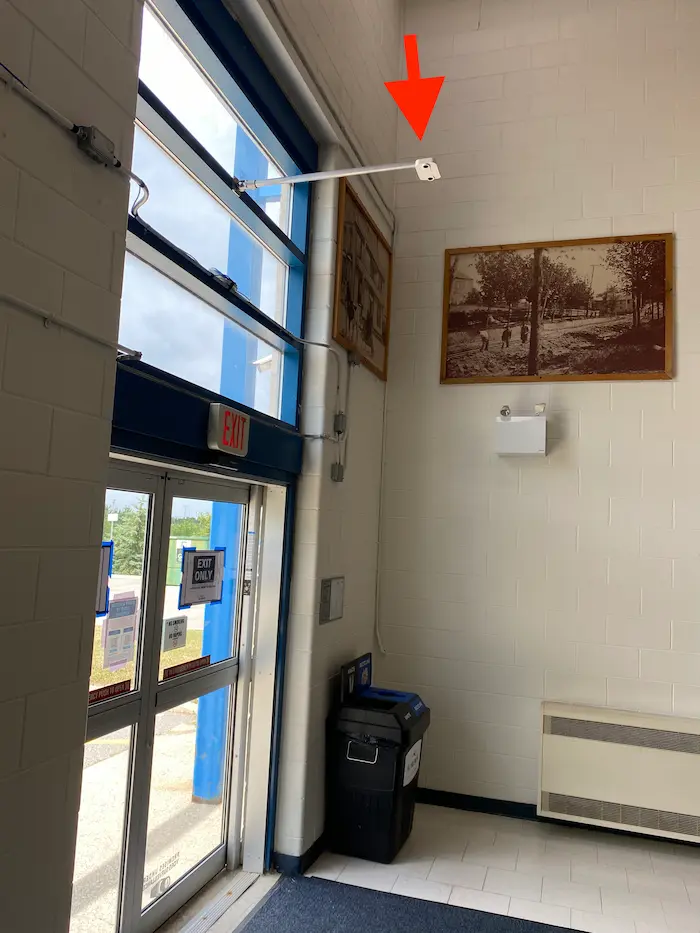
3D people counting sensor installed above a retail entrance — compact, discreet, and continuously accurate
Data from every sensor flows to a cloud-based platform in real time. A facility manager with multiple locations can see current occupancy at every site from a single dashboard on their phone. A retail operations director can pull a comparison of footfall across fifty stores for the past thirty days in minutes. A public library can generate its annual visitor count report for the funding authority with a single export — from verified, continuous data rather than extrapolated sample counts.
For retail and hospitality environments where the distinction between customer and staff footfall is critical for conversion rate analysis, Smart Sensor Solutions systems support automatic staff filtering — using simple, discreet identification tags that allow the system to separate employee movement from customer traffic without any manual adjustment.
Retail Space Management — Turning Footfall Into Revenue Intelligence
For retail environments — whether a single independent store or a national chain — indoor people counting is the data foundation that makes performance management evidence-based. Without it, the most fundamental retail metric — how many people visited — is unknown, which means conversion rate, marketing effectiveness, and staff productivity ratios are all estimates rather than facts.
With it, the analytical possibilities multiply. How does footfall vary by day, time, season, and local event? Does a marketing campaign increase store visits, or just average transaction size? Which store in a chain performs best relative to its traffic volume? Are customers spending time in the premium product zones, or bypassing them? Does a layout change — moving a display, widening an aisle, repositioning the entrance welcome area — change dwell time in high-margin sections?
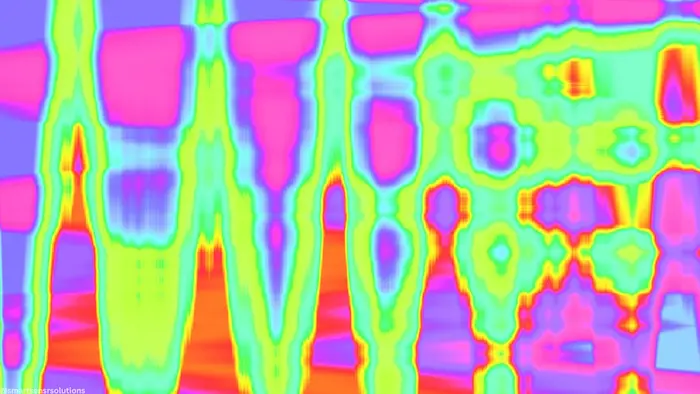
Traffic heat maps reveal which store zones attract the most visitors — and which areas customers consistently bypass
For multi-site retail operations, people counting data enables a comparison that no other metric supports: normalised performance across locations with different footfall levels. Store A may have lower sales than Store B, but if Store A converts a higher percentage of its visitors into buyers, it is actually the stronger performer on the metric that reflects team and execution quality. Without footfall data, this insight is invisible.
Occupancy Control — Safety, Compliance, and Peace of Mind
Occupancy control is the safety-critical application of people counting. Rather than simply recording how many people visit, occupancy control maintains a running net count — entries minus exits — and compares it continuously to a defined maximum. When the count approaches the limit, alerts are generated. When it reaches the limit, access management systems can be triggered to hold additional entrants until the count clears.
This matters for any facility with a maximum occupancy requirement — which, under fire code and building safety regulations, means almost every commercial and public space. Gyms managing capacity during peak hours, event venues managing crowd density, retail stores during sale events, and public buildings during community gatherings all face occupancy limits that manual monitoring cannot reliably enforce.
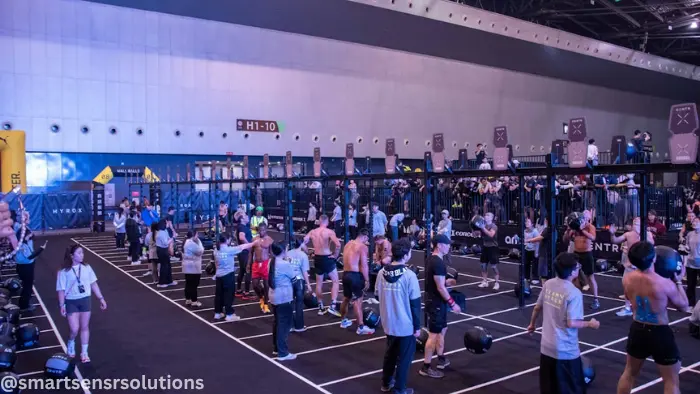
Gyms and fitness centres use real-time occupancy control to manage peak periods safely and keep members informed
Beyond compliance, occupancy control improves the visitor experience. Members of a gym who can check current occupancy before they travel avoid the frustration of arriving to find a full facility. Customers at a popular store during a peak event period can see queue wait times based on real occupancy data. Public venue visitors can be directed to less-crowded areas based on live zone counts. The data that keeps the space safe also makes it more pleasant to use.
Occupancy control systems can be configured to send automatic alerts to facility managers when occupancy reaches 80%, 90%, or 100% of defined limits — giving staff time to manage access proactively rather than responding to a limit breach after it has already occurred.
The Analytics Layer — From Raw Counts to Actionable Intelligence
A people counter that produces a daily total is useful. A people counter connected to a cloud analytics platform that shows historical trends, multi-site comparisons, time-of-day distributions, and automated reports is transformative. The difference is not the sensor — it is what happens to the data after the count is made.
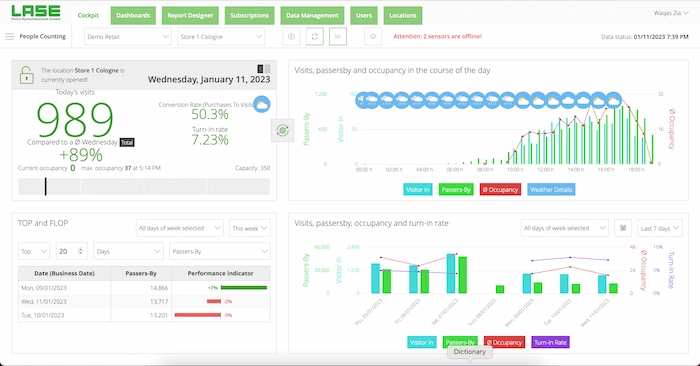
Cloud analytics dashboard — live occupancy, historical trends, and multi-location performance from any device
Real-Time Occupancy View
Current occupancy at every monitored location, updated continuously. Accessible on desktop, tablet, or mobile — so facility managers have live situational awareness wherever they are.
Historical Traffic Analysis
Visitor volume by hour, day, week, month, and year. Identify long-term trends, seasonal patterns, and the impact of specific events, campaigns, or operational changes on footfall.
Multi-Site Benchmarking
Compare footfall and conversion performance across all locations from a single dashboard. Identify top and bottom performers, share best practices, and allocate resources where visitor volume justifies them.
Automated Reporting
Scheduled reports delivered automatically to relevant stakeholders — daily summaries for store managers, weekly overviews for operations teams, monthly performance reports for executives, and annual visitor counts for funding bodies or boards.
API Integration
Footfall data connects via API to POS systems for conversion rate calculation, scheduling software for staffing optimisation, digital signage for live occupancy display, and business intelligence platforms for combined analytics.
Public Buildings and Libraries — Proving Value with Data
For publicly funded facilities — libraries, community centres, recreation centres, museums, and civic spaces — people counting serves a different but equally important function. The primary use is not revenue optimisation but accountability: demonstrating to funding bodies, municipal governments, and the public that the facility is being used, how intensively, and whether the investment in services and infrastructure is justified by demand.
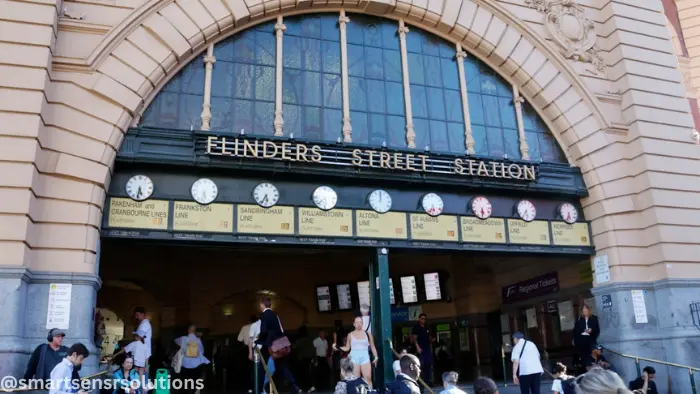
Libraries and public facilities use people counting data to demonstrate community value to funding bodies and municipal governments
A library that can show 347,000 visits in the past year — broken down by branch, day of week, and time of day — is in a fundamentally stronger position when applying for budget increases, arguing against closure, or justifying extended hours than one that can only offer attendance estimates from staff observation. The data does not just support the argument — in many cases, it is the argument.
“The organisations that benefit most from people counting are not the ones with the biggest spaces — they are the ones willing to let data replace assumptions about how those spaces are actually used.”
— Smart Sensor Solutions
What a Smart Sensor Solutions Indoor Counting System Delivers
- Accurate visitor counts at every entrance — 3D sensor technology with greater than 98% accuracy in both directions simultaneously
- Real-time occupancy monitoring — live net count compared to configurable maximum, with alert thresholds
- Staff filtering capability — automatic separation of employee footfall from customer traffic for accurate conversion metrics
- Cloud analytics dashboard — historical trends, multi-site comparison, and automated reports accessible from any device
- Occupancy limit alerts — configurable notifications when occupancy approaches defined safety thresholds
- Multi-location management — all sites in one dashboard, no manual data consolidation required
- API integration — connects to POS, scheduling, signage, and BI platforms via standard data interfaces
- Automated visitor reporting — for funding bodies, municipal governments, boards, and operational teams
- Privacy compliant — no images, no faces, no personal data — GDPR and PIPEDA compatible by design
- Scalable deployment — start with one location or one entrance, expand to full network coverage as needed
Indoor people counting is one of the highest-return sensor deployments available to facility operators. The data it generates touches staffing costs, space productivity, safety compliance, marketing effectiveness, and funding applications simultaneously. The question is not whether your organisation could benefit from knowing how many people use your space and when — it is whether you can afford to keep operating without that knowledge.
Ready to Know How Your Space Is Really Being Used?
Whether you manage a single retail location or a network of public facilities — we can design an indoor people counting solution that fits your space, your budget, and your operational objectives.
Serving facilities across Canada and the United States · Tel: +1 (855) 613 4486 · info@smartsensrsolutions.com