RADAR or LiDAR? The Answer
Depends on What You’re Counting.
Neither technology is the default. RADAR is a strong, cost-effective choice for straightforward vehicle counts. LiDAR earns its place — and often its price premium — when pedestrians and cyclists are part of the count. Here’s how to tell which one your site actually needs.
A lot of vendors in this space sell one sensor. Whatever the site looks like, whatever the specification calls for, the answer is the same box. That approach is easy to sell — but it isn’t always the right fit, and it isn’t always the best use of a project’s budget.
RADAR and LiDAR aren’t competing for the same job. RADAR has been the workhorse of vehicle detection for decades: it’s reliable in rain, fog, and darkness, it covers long distances and wide arterials, and for a project that only needs vehicle volumes and speed, it’s usually the more cost-effective choice. LiDAR is a newer, more precise technology — it builds a fine-grained point cloud of everything in its field of view, which is what lets it tell a pedestrian from a cyclist from a stroller at close range, in a way RADAR generally can’t match.
That difference matters more than it might seem. As soon as a project needs to count and classify pedestrians and cyclists — not just vehicles — object separation accuracy becomes the priority, and that’s the specific strength LiDAR was built for. Choosing RADAR for a mixed-mode intersection because it’s the familiar option can mean undercounting the exact road users a project may care most about protecting.
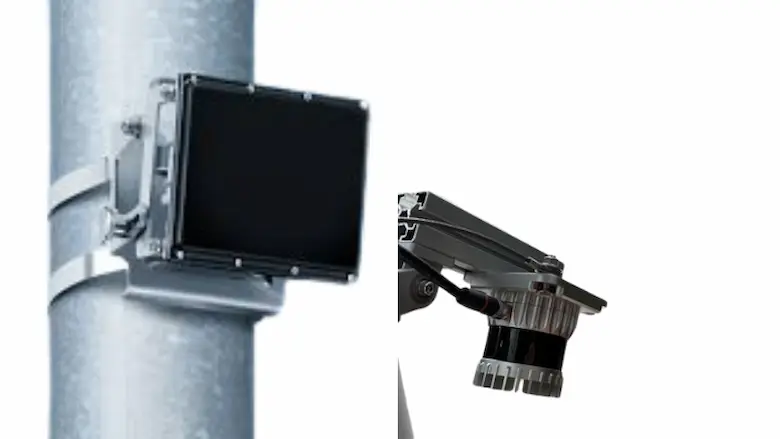
Different sites — and different road users — call for different sensing technology.
RADAR is the efficient choice when the count is vehicles only. LiDAR is the more accurate choice the moment pedestrians and cyclists are part of the specification. The right sensing solution is defined by what’s being counted, not by which sensor is easiest to default to.
Here’s how each technology earns its place — and where a hybrid approach makes sense.
Four Things That Actually Determine the Right Sensor
Before recommending hardware, these are the questions that shape the decision.
Who’s Being Counted
Vehicle-only counts play to RADAR’s strengths — range, weather resilience, and cost-efficiency. The moment pedestrians and cyclists need to be separated and classified accurately, LiDAR’s finer object resolution becomes the deciding factor.
Lane Count and Range
Wide arterials spanning many lanes favour RADAR’s longer effective range. Tighter intersections and crossings, where precision at close range matters more than distance, favour LiDAR.
Lighting and Weather
RADAR performs consistently in rain, fog, and full darkness. LiDAR performs very well in most conditions but is the more demanding — and more precise — technology, which is part of why it typically costs more per unit.
Installation Constraints
Most projects install on existing poles and tap existing power rather than budgeting for new civil works. Both RADAR and LiDAR units are available in configurations built for that kind of retrofit.
RADAR, LiDAR, or Hybrid — Matched to Who You’re Counting
As the North American distributor and integrator for LASE PeCo’s RADAR and LiDAR sensing platforms, we’re not tied to selling one device family. Here’s how each technology earns its place.
RADAR: The Efficient Choice for Vehicle-Only Counts
Our RADAR line spans multiple detection ranges and fields of view — from focused coverage on 4 lanes up to 300m range across 12 lanes. RADAR performs consistently in rain, fog, and darkness, and it’s the more cost-effective option when the specification is vehicle volume, classification, and speed, without needing to separately track pedestrians or cyclists.
LiDAR: The More Accurate Choice for Pedestrians and Cyclists
Our LiDAR platform delivers sub-centimetre object separation — the level of detail needed to reliably tell a pedestrian from a cyclist from a vehicle at close range. At intersections and crossings where vulnerable road users are part of the count, this precision is why LiDAR is usually our first recommendation, even though it typically carries a higher per-unit cost than RADAR.
Hybrid: Full Coverage Without Compromise
Some sites need both — long-range vehicle detection across a wide arterial and precise pedestrian/cyclist counting at an adjacent crossing. Combining RADAR and LiDAR, or a RADAR-plus-camera unit for visual reference, covers both requirements in one deployment instead of forcing a compromise between range and precision.
One Login, Every Sensor Type
This is the part that gets missed when hardware is chosen device-by-device: whether a site runs RADAR, LiDAR, or a hybrid unit, the counts, classifications, and speed data all land in the same LASE Analytics Portal. One sign-on, one reporting layer, one set of dashboards and API endpoints — regardless of which technology sits on which pole.
How We Get to the Right Recommendation
Matching technology to spec isn’t guesswork — it follows the same process for every project.
Start With Who’s Being Counted
Vehicles only, or vehicles plus pedestrians and cyclists? This single question does more to determine the right sensor than any other factor, and it comes before lane count, range, or budget.
Weigh Range Against Precision
If the priority is covering a wide arterial reliably in all weather, RADAR’s range and resilience win out. If the priority is accurately separating close-together road users, LiDAR’s precision wins out — even at a higher cost per unit.
Design for the Infrastructure That Exists
Existing pole and power constraints shape what’s practical to install. We confirm this early so the proposed hardware — RADAR, LiDAR, or hybrid — fits without triggering costs the project didn’t budget for.
Bring It All Into One Reporting Layer
Whatever mix of RADAR, LiDAR, or hybrid units the project ends up with, every device reports into the same analytics portal — so the technology decision behind the scenes never becomes a reporting headache in front of the dashboard.
RADAR is the efficient answer for vehicle-only counts. LiDAR is the more accurate answer wherever pedestrians and cyclists are part of the picture. Neither is the default — the count requirement decides, and when in doubt, precision at close range is usually worth the investment.
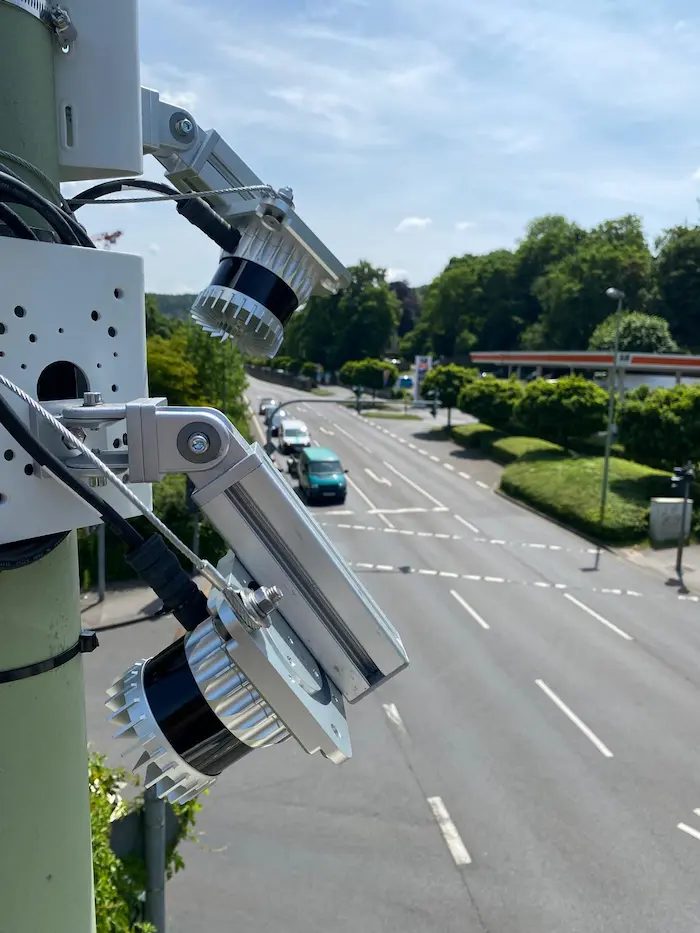
LC3.0 Pro
One example of matching hardware to spec: at intersections and crossings where vulnerable road users need to be counted and classified accurately, this LiDAR unit is often the right fit — not because it’s the newest technology, but because its close-range object separation lines up with what that kind of site actually needs.
With a full 360° horizontal field of view and 0.5cm accuracy, it’s built for the precision that RADAR alone isn’t designed to deliver at short range.
RADAR or LiDAR? Ask These Questions First
Six questions worth answering before settling on a single sensor type for a project.
-
Does the count need to include pedestrians and cyclists? — if yes, LiDAR’s precision usually makes it the stronger choice
-
Is the count vehicles only? — RADAR is typically the all-weather option for this case
-
What’s the lane count and roadway type at each site? — wide arterials favour RADAR’s range; tight crossings favour LiDAR’s precision
-
What lighting and weather conditions will the sensor face? — this affects whether RADAR, LiDAR, or a hybrid is the better fit
-
Can the sensor mount on existing poles and tap existing power? — avoids unbudgeted civil works
-
Will all sensor types report into one dashboard? — a mixed technology deployment shouldn’t mean multiple logins
Frequently Asked Questions
Is LiDAR always better than RADAR?
Not always — it depends on what’s being counted. For vehicle-only volume and speed data, RADAR is usually the more cost-effective choice and performs reliably in all weather. LiDAR’s advantage is precision: when pedestrians and cyclists need to be separated and classified accurately, especially at close range, LiDAR generally outperforms RADAR and is worth the higher per-unit cost.
Why does LiDAR cost more than RADAR?
LiDAR builds a detailed 3D point cloud of everything in its field of view, which requires more sophisticated sensing hardware than RADAR’s range-and-speed detection. That added precision is exactly why LiDAR is the stronger choice for pedestrian and cyclist counting — the cost premium buys the object separation accuracy those use cases need.
Can RADAR and LiDAR be combined on the same project?
Yes. A common approach is RADAR for long-range vehicle detection along an arterial, paired with LiDAR at specific crossings or intersections where pedestrian and cyclist precision matters most. Both feed into the same LASE Analytics Portal, so the mixed deployment still reports through a single dashboard.
Not Sure Whether You Need RADAR or LiDAR? Let’s Find Out
Tell us what you need to count — vehicles, pedestrians, cyclists, or all three — and site conditions, and we’ll recommend the technology that actually fits, not just what’s in one product line.
Serving Canada and the United States · Tel: +1 (855) 613 4486 · info@smartsensrsolutions.com