
At some point, every transit agency runs into the same wall: the ridership data coming off its current Automatic Passenger Counting (APC) system just isn’t good enough anymore. Counts drift. Door sensors fail quietly. Data shows up late — or not at all — right when it’s needed for a board report or a funding compliance filing.
When agencies start scoping a replacement, the requirements list grows fast: cybersecurity alignment with frameworks like NIST 800-53, no commingling of data between customers, AD-only accounts with no local logins, VPN-tunneled onboard connectivity, 95%+ stop-level accuracy, same-day-or-better data availability, automated matching against scheduling systems like Trapeze FX, and a validation program that holds up to independent manual counts. None of that is exotic — it’s simply what a modern, auditable, defensible counting system has to do in 2025.
The question worth asking before a single spec gets written: is there a solution built from the ground up to check every one of these boxes — without a dozen vendors and integrators stitched together, each responsible for a different point of failure?
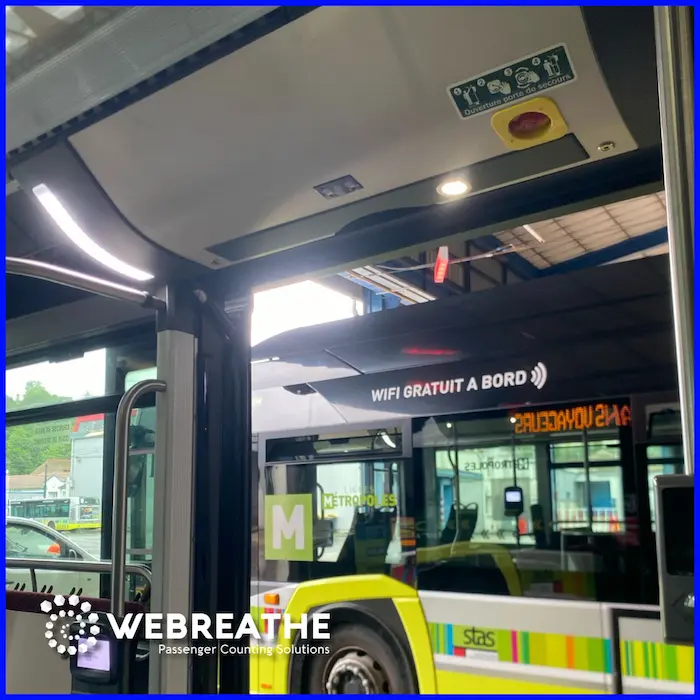
A counting sensor small enough to disappear into virtually any door frame.
Most APC vendors resell someone else’s sensor, someone else’s onboard computer, and someone else’s dashboard — then act as integrator when something breaks. A single-manufacturer stack removes that hand-off entirely.
That’s the case for taking a closer look at the passenger counting solution we deliver, built on Webreathe’s 2FLOW platform — a fully owned, fully integrated sensor, onboard computer, and software suite. Here’s how it actually maps to the requirements agencies are writing into their specs today.
Six Requirements That Show Up in Nearly Every APC Spec
Whatever the fleet size or vehicle mix, most agencies converge on the same core demands. Here’s the short version of each.
Cybersecurity by Design
NIST-aligned controls, encrypted data at rest and in transit, AD-only accounts, no anonymous connections, and full activity auditing — not a checkbox added after the fact.
Hardware That Actually Fits
Every fleet has a different mix of door heights, vehicle types, and existing sensor cutouts. A sensor too large or rigid to retrofit cleanly becomes a budget problem fast.
Accuracy That’s Actually Verifiable
A headline accuracy number means little without a transparent, repeatable methodology behind it — one that holds up against an independent manual count.
Reliable Onboard Connectivity
Many specs explicitly rule out Wi-Fi for data transfer, requiring hardwired ethernet and VPN-tunneled transmission instead — for both security and reliability reasons.
Scheduling & AVL Integration
Ridership data has to match cleanly against the agency’s scheduling system — routes, trip exceptions, and ad hoc service changes — without a mountain of manual reconciliation.
Timely, Trustworthy Reporting
Agencies set real internal deadlines: issues flagged within days, preliminary ridership released quickly, finalized numbers ready well ahead of monthly/annual reporting.
How the 2FLOW Platform Maps to Each Requirement
Our automatic passenger counting solution was engineered around exactly these demands, because the sensor, onboard computer, and software were designed by the same team, at the same time, to work together. Here’s how it lines up point for point.
Security built into every layer
The platform aligns with the ISO 27001 standard and encrypts data across the sensor, onboard computer, server, and software interface. Admin and user access are separated at every tier, and client data is never commingled — a baseline design principle, not an add-on module.
A sensor small enough to disappear
EYES 3 is roughly half the size of comparable sensors on the market, fits single and double doors, and stays accurate across installation heights from 1.9m to 3.5m — critical for fleets spanning low-floor buses to legacy rail cars with very different door geometries.
Accuracy that’s methodology-transparent
The platform’s 98%+ accuracy figure is measured against absolute error across a minimum of 1,000 entries/exits per direction, over at least 100 door-opening cycles under real operating conditions — the same rigor most agencies require in a contradictory manual-count validation.
Hardwired connectivity, not a Wi-Fi workaround
WEBOX ships with a genuine 8-port ethernet switch (4 with PoE) and dual network cards for segregated traffic, built to hardwire cleanly into an existing onboard network with secure VPN tunneling to the backend.
Scheduling integration without custom middleware
2FLOW imports GTFS directly and interfaces with AVL systems like Trapeze FX out of the box, so counting data lines up automatically with the correct line, direction, and stop — no manual reconciliation required.
Live data, not a monthly dump
Counting, geolocation, and timestamping happen at the sensor and transmit continuously to the cloud, giving agencies a real-time operational view instead of waiting on batch processing.
“The Achilles’ heel of most counting systems is the reliability and performance of the underlying data. Owning the entire production chain — from onboard sensor to final report — is what makes that data trustworthy.”
— Webreathe, 2FLOW platform overview
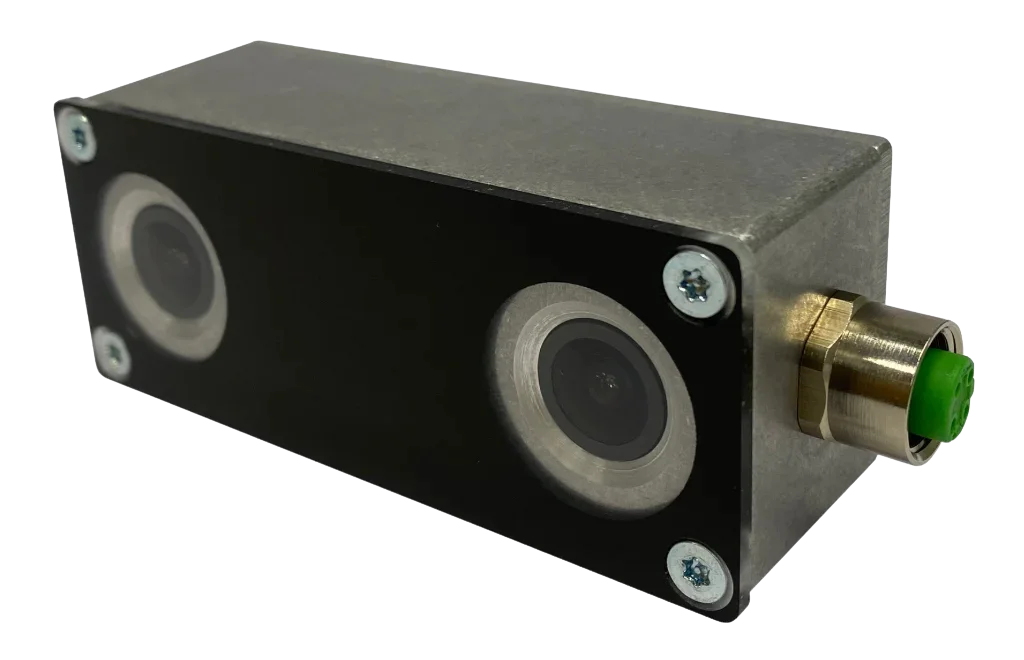
EYES 3 — The Smallest Counting Cell on the Market
A 3D stereoscopic sensor powered by AI, designed to fit discreetly into single or double doors on any vehicle type — bus, tram, metro, or commuter rail — without the bulky housing older systems require.
Counting starts automatically on the door-open signal and stops on door-close, with classification of adults, children, wheelchairs, strollers, and bikes built in — no separate module needed.
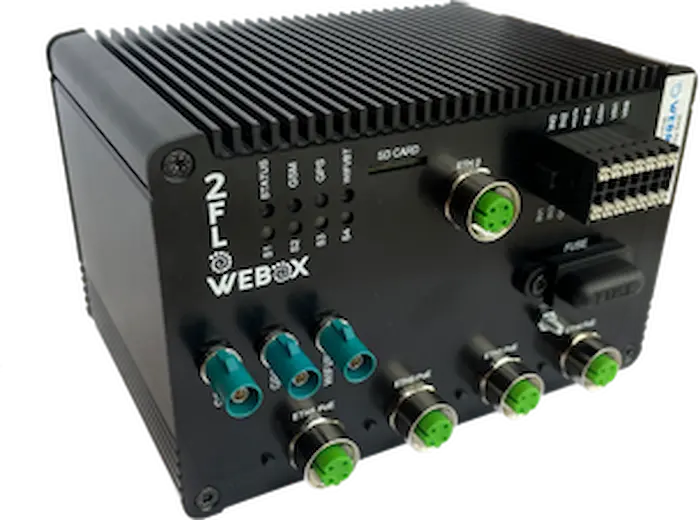
WEBOX — One Box Instead of Five
An onboard computer, GPS/GLONASS location beacon, 4G router, and 8-port managed switch in a single miniature device — replacing the patchwork of separate boxes most retrofit projects otherwise require.
Dual network cards keep counting traffic segregated from other onboard systems, while secure VPN tunneling handles all data transmission to the backend — no onboard Wi-Fi required.
Questions Worth Asking Any APC Vendor
Before locking in a spec or shortlisting vendors, these are the questions that tend to separate a genuinely integrated platform from a bundle of third-party parts.
- Who manufactures the sensor and the onboard computer? — If it’s not the vendor in front of you, ask who owns the fix when something breaks.
- How is the accuracy number calculated? — Ask for the sample size, door-cycle minimum, and whether it’s been validated against manual counts.
- Does the sensor require one cell per door or two? — This affects retrofit cost and how cleanly it replaces legacy hardware.
- What cybersecurity standard is the platform aligned to? — ISO 27001 or NIST 800-53 alignment should be demonstrable, not just claimed.
- Does it require onboard Wi-Fi, or does it work over hardwired ethernet with VPN tunneling? — Many agencies rule out Wi-Fi for data transfer entirely.
- Does it integrate directly with your AVL/scheduling system via GTFS? — Or will it require custom middleware to match ridership data to routes and stops?
- What railway/EMC certifications does the hardware already hold? — Especially relevant for any rail vehicles in a mixed fleet.
- Is passenger data anonymized at the sensor, or transmitted as raw video? — This affects both privacy compliance and bandwidth requirements.
Frequently Asked Questions
How accurate are modern automatic passenger counting sensors?
Leading 3D stereoscopic sensors, like EYES 3, are validated above 98% accuracy under real operating conditions — measured against absolute error across a large sample of entries/exits and door cycles, not a lab-only figure. Ask any vendor for their exact validation methodology before comparing numbers.
Does an APC upgrade require replacing the entire onboard network?
Not with an integrated platform. WEBOX-style onboard computers include their own managed switch and dual network cards, so they can hardwire into existing systems (AVL, ticketing, driver console) without a full network rebuild.
Can APC data integrate with an existing AVL or scheduling system?
Yes — platforms built around GTFS import can match counting data automatically to the correct line, direction, and stop, and interface with AVL systems like Trapeze FX without custom middleware.
Scoping an APC Upgrade? Let’s Talk Through Your Fleet.
Whatever mix of buses, trams, or rail cars you’re working with, we can walk through how a fully integrated counting platform fits your security, accuracy, and reporting requirements.
Serving Canada and the United States · Tel: +1 (855) 613 4486 · info@smartsensrsolutions.com
